

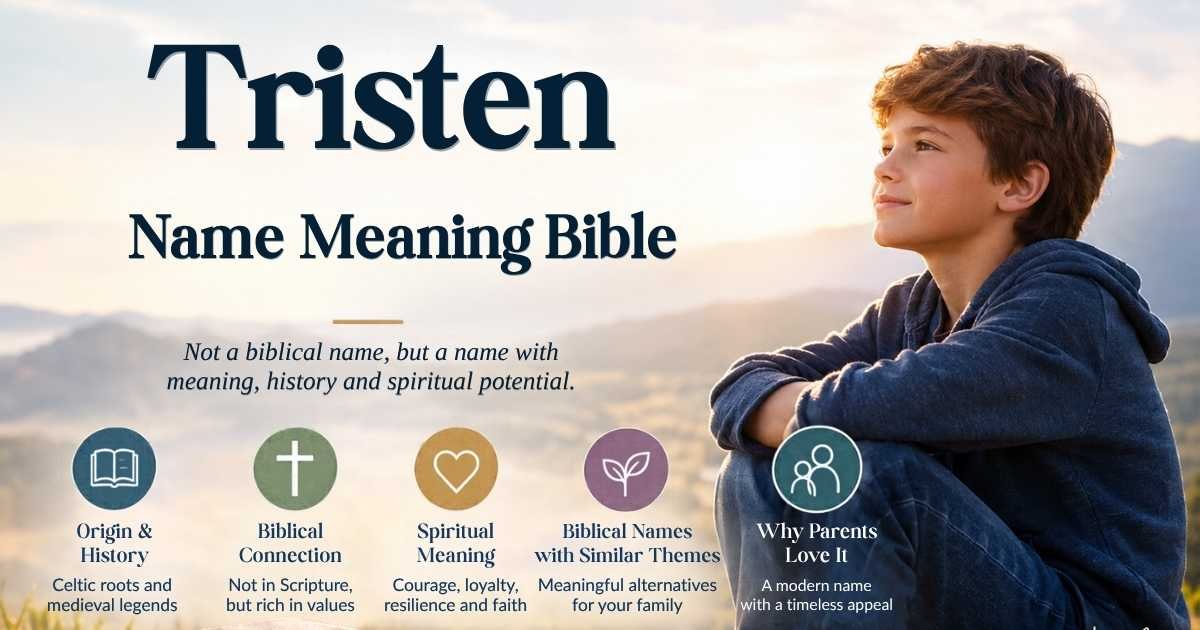
Many parents search for the Tristen name meaning in the Bible because they want a name that sounds beautiful, carries a meaningful story, and reflects their faith. If you are considering Tristen for your baby or simply want to understand its spiritual significance, it is important to separate its historical origin from the values Christians may associate with it.
Tristen is not a name found in the Bible, and it does not have an established biblical meaning. It is generally treated as a variant of Tristan, a name associated with Celtic and medieval European traditions. However, its themes of courage, loyalty, perseverance, and overcoming sorrow can remind Christian families of important biblical teachings.
In this guide, you will discover where Tristen comes from, whether it appears in Scripture, what spiritual symbolism it may carry, and how you can connect the name with your Christian faith.
Where Does the Name Tristen Really Come From?
Tristen is commonly used as an alternative spelling of Tristan. Its history is connected with medieval European naming traditions, particularly the legendary story of Tristan and Iseult. Although the name has a long cultural history, it does not originate from a biblical character or a Hebrew name recorded in Scripture.
The older form Tristan is often traced to the Pictish name Drustan. Its precise linguistic history is debated, but some explanations connect it with a Celtic root associated with noise, commotion, or tumult. The name also became associated with the French word triste, meaning sad or sorrowful. This connection was strengthened by the tragic medieval romance of Tristan and Iseult.
In the legend, Tristan is a knight whose love for Iseult leads to a complicated and tragic story. The tale became popular throughout medieval Europe and helped establish Tristan as a recognizable name. Over time, alternative spellings, including Tristen, developed and became part of modern naming practices.
Here is a simple breakdown of the name’s background:
- Name: Tristen
- Common variation: Tristan
- Historical background: Celtic and medieval European traditions
- Possible linguistic associations: Tumult or commotion
- Cultural association: The tragic romance of Tristan and Iseult
- Biblical origin: No established biblical origin
It is worth remembering that the history of a name and the meaning a family gives it are not necessarily the same. A name can come from a nonbiblical tradition while still reminding its bearer of Christian principles.
For example, parents may associate Tristen with bravery, faithfulness, or the ability to overcome difficult circumstances. Those are personal spiritual associations rather than verified biblical definitions.
Also read: Emma Name Meaning in Bible: Hebrew & Christianity
Why So Many People Assume Tristen Is Biblical
There are several reasons people search for Tristen’s biblical meaning. First, its sound resembles familiar biblical names such as Tobias, Nathaniel, and Jonathan. This similarity may lead people to believe that Tristen also comes from Hebrew or appears somewhere in Scripture.
Another reason is that many parents prefer names with religious significance. When choosing a name for a child, they may look for a connection to faith, a Bible verse, or a positive character trait. As a result, a modern name can become associated with spiritual qualities even when its historical roots are different.
Online baby-name articles can also contribute to confusion when they present symbolic interpretations as established meanings. Words such as faith, strength, and gift from God may sound appropriate for a Christian family, but they should not automatically be presented as the literal meaning of Tristen.
The distinction is straightforward: Tristen has a nonbiblical historical background, but Christian parents can give it personal spiritual significance. Understanding this difference allows families to appreciate the name without relying on inaccurate claims about its origin.
Does Tristen Appear Anywhere in Scripture?
No. Tristen does not appear as a biblical name in commonly used translations such as the King James Version (KJV), the New International Version (NIV), or the English Standard Version (ESV). Tristan, the more widely recognized variation, is not identified as a biblical character either.
The Bible contains many names with identifiable Hebrew, Aramaic, or Greek backgrounds. Some belong to prophets, kings, apostles, and other important figures. Their stories help readers understand the historical and spiritual significance associated with those names.
For example:
- Joshua: Associated with the Hebrew name Yehoshua, commonly understood as “the LORD is salvation.”
- Daniel: Commonly understood as “God is my judge.”
- Nathaniel: Derived from a Hebrew name meaning “God has given.”
- Gabriel: Commonly interpreted as “God is my strength.”
- Jonathan: Derived from a Hebrew name meaning “the LORD has given.”
Tristen does not have the same direct connection to biblical language or Scripture. Therefore, it would be inaccurate to describe it as the name of a biblical prophet, disciple, or minor biblical character.
However, a name does not have to appear in the Bible for a Christian family to choose it. Many modern names have cultural or historical origins outside Scripture. Parents can still raise children with biblical values, teach them about Jesus, and encourage them to develop a strong relationship with God.
If you are considering Tristen, you can focus on the values you want the name to represent rather than searching for a biblical character who never appears in the text.
The Symbolic and Spiritual Meaning of Tristen
Although Tristen has no established biblical meaning, some of its cultural associations can inspire personal spiritual reflection. Christian families may connect the name with courage, hope during hardship, and loyalty to the people they love.
These themes are found throughout Scripture. The following interpretations are symbolic connections, not literal definitions of the name.
1. Courage and Adventure
One quality people may associate with Tristen is courage. The name’s connection with the legendary knight Tristan can bring to mind bravery, determination, and the willingness to face difficult situations.
Courage is also an important biblical theme. In Joshua 1:9, God tells Joshua to be strong and courageous and reminds him that He will be with him wherever he goes. The verse encourages believers to face uncertainty with faith rather than allowing fear to control their decisions.
For Christian parents, this teaching can provide a meaningful way to connect Tristen with their hopes for a child. They may want their son to grow into someone who stands up for what is right, treats others fairly, and continues doing good even when circumstances become challenging.
Courage does not mean that a person never feels afraid. It means choosing to act wisely and faithfully despite fear. A child named Tristen can learn this lesson through family conversations, Bible stories, prayer, and everyday examples of kindness.
If courage is the quality you want the name to represent, Joshua 1:9 is a meaningful verse to include in a baby dedication, birthday card, or family keepsake.
2. Sorrow Transformed Into Strength
The association between Tristan and the French word triste, meaning sorrowful, gives the name another possible layer of symbolism. This connection should not be treated as its definitive etymological meaning, but it can inspire reflection on the relationship between hardship and hope.
The Bible acknowledges that sadness and suffering are part of human life. It also teaches that difficult seasons do not have to define a person’s future.
Psalm 30:5 offers a familiar message of hope: weeping may last through the night, but joy comes in the morning. The verse reminds believers that sorrow is not necessarily permanent and that seasons of pain can give way to renewed hope.
Similarly, James 1:2–3 discusses how the testing of faith can develop perseverance. This does not mean that suffering is easy or that every painful experience has an obvious explanation. Rather, it encourages believers to remain faithful while navigating life’s challenges.
Parents who choose Tristen may interpret this symbolism as a reminder that their child can develop resilience, compassion, and patience. They may hope he will learn from setbacks without losing hope or becoming unkind toward others.
In this sense, the name can become a personal reminder that strength is not simply about avoiding hardship. Sometimes, strength means seeking help, accepting support, learning from mistakes, and continuing forward with faith.
3. Loyalty and Devotion
Loyalty is another quality that may be associated with Tristen because of the medieval romance of Tristan and Iseult. Their story explores love, commitment, and complicated relationships, although it should not be treated as a biblical model of devotion.
Christian Scripture offers a different foundation for understanding faithfulness. Proverbs 3:3 encourages readers not to abandon love and faithfulness but to keep these qualities close to their hearts.
Biblical loyalty includes more than remaining attached to another person. It involves honesty, kindness, responsibility, and a commitment to doing what is right. Faithfulness can be demonstrated through keeping promises, supporting family members, treating friends with respect, and maintaining integrity when nobody is watching.
Parents may connect Tristen with these qualities because they want their child to become someone others can trust. A loyal person does not simply agree with everyone; instead, that person seeks to act with sincerity, compassion, and wisdom.
For a Christian family, Tristen can therefore serve as a personal reminder of devotion to God and care for others. Its historical origin remains separate from Scripture, but the values attached to it can be taught through biblical principles.
Biblical Names With Similar Themes to Tristen
If you like Tristen but prefer a name with a direct biblical connection, several alternatives may appeal to you. The best choice depends on whether you are drawn to courage, faithfulness, perseverance, or strength.
| Biblical name | Commonly understood meaning | Connection to the theme |
|---|---|---|
| Joshua | The LORD is salvation | Courage and trust in God |
| Caleb | Traditionally associated with “wholehearted” or “faithful”; the precise interpretation is debated | Loyalty and devotion |
| Jonathan | The LORD has given | Friendship and faithfulness |
| David | Beloved | Love, leadership, and devotion |
| Daniel | God is my judge | Integrity and faith |
| Gabriel | God is my strength | Strength and God’s power |
| Job | The name’s precise etymology is debated | Perseverance through suffering |
| Boaz | The name’s meaning is uncertain, often associated with strength | Kindness and responsibility |
Joshua is a strong option for parents who want a name connected with courage and trust in God. Jonathan may appeal to those who value friendship and loyalty, especially because of his relationship with David in the biblical narrative.
Daniel is another meaningful choice for families who admire integrity. His story emphasizes faithfulness to God despite pressure and difficult circumstances.
If you prefer the sound of Tristen, you do not necessarily need to replace it. You could choose a biblical middle name, such as Tristen David, Tristen Joshua, or Tristen Daniel. These combinations preserve the name you like while incorporating a name with a direct scriptural background.
Remember that the meanings of biblical names can vary across linguistic and historical sources. When choosing a name, consider both its established history and the personal significance it holds for your family.
Why Christian Parents Still Love the Name Tristen
Christian parents may choose Tristen for many reasons, even though it is not a biblical name. Some appreciate its modern sound, while others like its cultural history or the positive character traits they associate with it.
A meaningful name can be part of a child’s identity, but it does not determine the person’s character or spiritual future. Parents help shape those qualities through love, guidance, example, and faith.
It Carries a Strong, Meaningful Legacy
Tristen is connected with the long-standing European legend of Tristan and Iseult. Although the story is tragic and differs considerably from biblical narratives, it has given the name a recognizable place in literature and cultural history.
Some parents are drawn to the themes of bravery, loyalty, and determination associated with the legendary knight. They may interpret these qualities as a reminder to raise their child to be courageous, responsible, and considerate.
A name’s legacy can also come from the family that chooses it. Perhaps Tristen honors someone important, reflects a treasured memory, or simply feels right to both parents. That personal story can become an important part of the child’s understanding of his name.
Christian parents can give this family story a faith-centered foundation by explaining the values they hope their child will develop.
It Sounds Bold and Timeless
Tristen has a clear, recognizable sound and an established connection to the traditional name Tristan. Its alternative spelling may appeal to parents who want a familiar name with a slightly different appearance.
The name can also work well with a range of middle names and surnames. For example, Tristen James, Tristen David, and Tristen Elijah offer different combinations depending on family preferences.
There is no single naming style that makes a name more Christian than another. Some families prefer names directly drawn from the Bible, while others choose names from different languages and cultures.
If you like Tristen’s sound, its lack of biblical origin does not automatically make it unsuitable for a Christian household. The important thing is to understand its background and choose it thoughtfully.
It Represents Resilience
Some families associate Tristen with resilience because of its possible sorrow-related associations and the tragic story connected with Tristan. This is a symbolic interpretation rather than a verified biblical definition.
Resilience is the ability to respond to challenges, adapt, and continue moving forward. From a Christian perspective, it can involve prayer, trust in God, support from loved ones, and the willingness to learn during difficult seasons.
Romans 5:3–4 describes a connection between suffering, perseverance, character, and hope. This passage can help parents explain that personal growth often requires patience and that hardships should not prevent someone from seeking goodness.
Parents who choose Tristen can use this idea to encourage their child to respond to mistakes with humility and to treat people experiencing difficulties with compassion.
Ultimately, resilience comes from a person’s experiences, choices, support system, and values. A name can remind someone of these ideals, but it does not guarantee that the person will automatically develop them.
How to Strengthen the Biblical Connection to Tristen
If you love Tristen and want to give it a stronger place in your Christian family, you can connect it with Scripture in several thoughtful ways. These practices create personal spiritual significance without changing the name’s historical origin.
1. Choose a biblical middle name. Pair Tristen with a name such as Joshua, David, Daniel, or Elijah. This gives the full name a direct connection to a biblical figure while allowing you to keep Tristen as the first name.
2. Select a meaningful Bible verse. Joshua 1:9 is a suitable choice if you associate Tristen with courage. Psalm 30:5 can serve as a reminder of hope during sorrow, while Proverbs 3:3 emphasizes love and faithfulness.
3. Write a personal naming blessing. During a baby dedication or family celebration, explain why you chose Tristen and which values you hope your child will develop. You might express the hope that he will grow in wisdom, show kindness, and trust God during difficult times.
4. Teach biblical values through everyday life. Children learn more from consistent examples than from a name alone. Show your child how to apologize, keep promises, help others, and make responsible decisions.
5. Create a name keepsake. You could prepare a framed card featuring Tristen’s name, its historical background, a family-written blessing, and a favorite Bible verse. Make it clear which details describe the name’s history and which express your family’s personal hopes.
These ideas allow parents to celebrate Tristen while remaining honest about its origin. The name does not need an invented biblical definition to become meaningful within a Christian home.
Common Misconceptions About Tristen’s Biblical Meaning
Several claims about Tristen circulate online, so it is helpful to distinguish established information from speculation.
Misconception 1: Tristen means “gift of God.”
There is no well-established linguistic evidence that Tristen has this meaning. Nathaniel, by contrast, comes from a Hebrew name commonly interpreted as “God has given.”
Misconception 2: Tristen is a Hebrew name.
Tristen is generally treated as a spelling variant of Tristan, which is associated with Celtic and medieval European traditions. It is not established as a Hebrew biblical name.
Misconception 3: Tristen appears in the Bible as a minor character.
Tristen and Tristan are not recognized as names of biblical characters in standard Bible translations. Claims that a character with this name appears in Scripture should be supported by a specific passage, not repeated without evidence.
Misconception 4: Tristen means “God is my strength.”
This is not an established meaning of Tristen. Gabriel is a biblical name commonly interpreted as “God is my strength.”
Misconception 5: A name must appear in the Bible to be acceptable for Christians.
The Bible does not provide a universal list of names that every Christian family must use. Christian parents may choose names from different linguistic and cultural backgrounds while raising their children according to their faith and values.
The main lesson is simple: a name’s historical meaning, symbolic associations, and personal religious significance are three different things. Keeping them separate helps parents make informed choices without losing the freedom to attach their own meaningful hopes to a name.
Tristen in Modern Christian Culture
In modern Christian families, the significance of a name often extends beyond its original language or historical background. Parents may consider a name’s sound, family traditions, cultural connections, and the values they hope to encourage in their child.
Tristen can fit into this approach. Although it is not directly biblical, a Christian family may associate it with courage, compassion, perseverance, or faithfulness. These associations can be expressed through a naming blessing, a chosen Bible verse, or conversations about character as the child grows.
The name can also be paired with a biblical first or middle name, depending on the family’s preference. Some parents may choose Tristen David, while others may prefer a name such as Tristen Elijah. The combination can reflect both personal taste and religious tradition.
It is important, however, not to confuse modern cultural use with historical evidence. The fact that a Christian person bears the name Tristen does not make it biblical in origin. Likewise, using the name in a Christian community does not establish a new Hebrew or scriptural meaning.
For parents, the most valuable question may be what they want the name to represent within their own household. A child can grow up learning Scripture, practicing kindness, and developing a sincere faith regardless of whether his name appears in the Bible.
Frequently Asked Questions About Tristen Name Meaning Bible
What does Tristen mean in the Bible?
Tristen has no established biblical meaning because it does not appear as a name in Scripture. It is commonly treated as a variant of Tristan, a name associated with Celtic and medieval European traditions. Christian families may personally connect it with courage, resilience, and faithfulness.
Is Tristen a biblical name?
No. Tristen is not recognized as a biblical name in standard translations such as the KJV, NIV, and ESV. Its historical background is European rather than directly biblical.
What is the spiritual meaning of Tristen?
There is no universally established spiritual meaning for Tristen. However, parents may associate it with positive values such as courage, loyalty, hope, and perseverance. These are personal symbolic interpretations, not literal meanings derived from Scripture.
Does Tristen mean “gift of God”?
No reliable, established etymology identifies Tristen as meaning “gift of God.” Nathaniel is a biblical name commonly understood to mean “God has given,” making it a more suitable option if that meaning is important to you.
Is Tristen a Christian name?
Tristen is not Christian in origin in the sense of coming directly from the Bible. Nevertheless, Christian parents can choose it for their child and give it personal significance through their family traditions, faith, and values.
What Bible verse goes well with the name Tristen?
Joshua 1:9 is a meaningful choice if you associate Tristen with courage and strength. Psalm 30:5 may suit a family that emphasizes hope after sorrow, while Proverbs 3:3 highlights love and faithfulness. These verses provide spiritual associations rather than definitions of the name.
What is the difference between Tristen and Tristan?
Tristen is generally used as an alternative spelling of Tristan. Both are associated with the same broader European naming tradition, although individual families may prefer one spelling for personal or cultural reasons. Neither is an established biblical name.
Is Tristen a good name for a Christian baby?
It can be, depending on your family’s preferences. There is no requirement that every name chosen by a Christian family must appear in the Bible. If you appreciate Tristen’s sound and history, you can choose it while teaching your child biblical principles and values.
What biblical names go well with Tristen?
Joshua, David, Daniel, Elijah, and Jonathan are possible middle-name choices. Each has a direct connection to biblical tradition and can complement Tristen while preserving the first name you prefer.
Is Tristen mentioned in the King James Bible?
No. Tristen does not appear as a biblical character in the King James Version. The same is true of Tristan, its more widely recognized spelling.
Final Thoughts: Tristen Name Meaning Bible Explained
The Tristen name meaning Bible question comes down to an important distinction: Tristen is not a biblical name, but it can still hold personal spiritual significance for a Christian family.
The name is generally associated with Tristan and its Celtic and medieval European background. Its possible connections with courage, sorrow, and loyalty come from historical and cultural associations rather than a direct definition in Scripture.
If you are considering Tristen for your baby, you do not need to invent a biblical origin to make the choice meaningful. You can connect the name with Joshua 1:9, reflect on the hope expressed in Psalm 30:5, or pair it with a biblical middle name.
Ultimately, a person’s character is shaped by their choices, relationships, experiences, and values—not by their name alone. If Tristen feels right for your family, you can give it a meaningful place in your Christian life while remaining honest about its history and origin.

Kai Rowan is a passionate content creator and the visionary behind a growing platform dedicated to the blessings niche. With a deep appreciation for positivity, gratitude, and spiritual inspiration, Kai curates meaningful content that uplifts and connects readers worldwide.
2 thoughts on “Tristen Name Meaning Bible: Biblical Interpretation, Origin & Faith Guide 2026”