

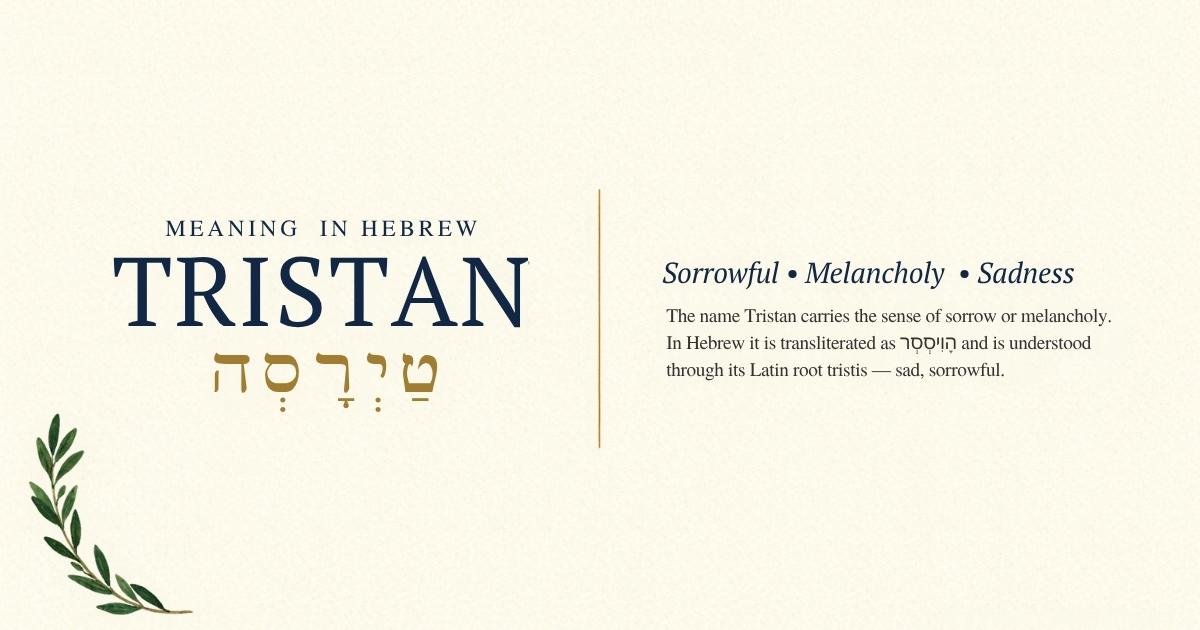
The Tristan meaning in Hebrew is a common question among parents and people who want to understand the spiritual significance of a name. Tristan is not originally a Hebrew name, and it does not appear as the name of a person in the Bible. However, its historical associations with sadness, courage, and emotional depth have encouraged people to explore its possible Christian meaning.
Although Tristan has no direct biblical definition, Christians can connect the name with important biblical themes such as hope, compassion, perseverance, and faith in God. Understanding the difference between a name’s historical origin and its spiritual interpretation helps us explore its meaning without attributing claims to Scripture that it does not make.
What Is the Tristan Meaning in Hebrew?
Tristan does not have a direct Hebrew meaning because it originated outside the Hebrew language. When written in Hebrew, the name is represented through transliteration, meaning its sounds are written using Hebrew letters. This does not make Tristan a Hebrew name or give it an original meaning in biblical Hebrew.
Some sources associate Tristan with sadness or sorrow, but these interpretations come from European naming traditions rather than Hebrew Scripture. Therefore, it would be inaccurate to claim that Tristan means “God’s gift,” “God is my strength,” or another Hebrew phrase without reliable linguistic evidence.
For Christians, the name can still carry personal significance. A family might associate Tristan with courage during difficult times or hope after sorrow. These are meaningful spiritual reflections, but they should remain separate from the name’s historical definition.
Is Tristan a Biblical Name?
No, Tristan is not a biblical name. It does not appear as the name of a person in either the Old Testament or the New Testament. Its origins belong to European naming traditions rather than the biblical world of ancient Israel.
However, a name does not have to appear in the Bible for a Christian family to choose it. Many Christian families use names from different languages and cultures. What matters is understanding the name’s background and choosing it thoughtfully.
The Bible emphasizes a person’s character, faith, and relationship with God rather than whether their name appears in Scripture. First Samuel 16:7 teaches that the Lord looks at the heart rather than outward appearance.
Parents considering Tristan can therefore focus on the values they want to encourage in their child, including kindness, honesty, courage, and love for others.
Also read: Tristen Name Meaning Bible: Biblical Interpretation, Origin & Faith Guide 2026
Where Does the Name Tristan Come From?
The name Tristan has a complex European history. Some name historians connect it with older Celtic or Pictish forms, including Drustan. Its later development was influenced by medieval French traditions, which helped establish the form of the name that is familiar today.
Tristan became widely known through the medieval legend of Tristan and Iseult. Their story explores love, loyalty, conflict, and tragedy. Because sorrow plays an important role in this tale, the name became associated with sadness in some interpretations.
The name’s history is not completely settled, so it is better to describe its origins cautiously rather than present one explanation as certain. Its European background also explains why there is no direct Hebrew translation or established biblical definition.
What Does Tristan Mean in the Bible?
The Bible does not give Tristan a specific meaning because the name does not appear in Scripture. Therefore, there is no official biblical interpretation of Tristan that can be established from a Bible verse.
Nevertheless, Christians may reflect on biblical themes that connect with the name’s traditional associations. If someone associates Tristan with sorrow, they might consider how Scripture describes God’s comfort during painful seasons. If they associate it with courage, they can reflect on the Bible’s encouragement to remain faithful during challenges.
Romans 5:3–4 explains that suffering can produce perseverance, character, and hope. This passage does not define Tristan, but it offers a biblical perspective on difficulties that can shape a person’s life.
The important distinction is that Tristan has no direct biblical meaning, but a Christian family can give it personal spiritual significance.
Does Tristan Mean Sorrowful or Sad?
Tristan is often associated with “sad” or “sorrowful.” This interpretation is commonly linked to the French word triste, meaning sad. However, the name’s possible older Celtic or Pictish roots make its exact original meaning uncertain.
The association with sorrow is also reinforced by the tragic elements of the Tristan and Iseult legend. Still, it would be misleading to say that every historical explanation confirms sorrowful as the name’s original meaning.
A name’s traditional association does not determine the personality or future of the person who carries it. Someone named Tristan can live a joyful, hopeful, and meaningful life.
Psalm 30:5 offers an encouraging reminder: “Weeping may endure for a night, but joy cometh in the morning” (KJV). Christians may connect this verse with the idea that sadness is not the end of a person’s story.
What Can Tristan Symbolize for Christians?
Although Tristan has no official biblical symbolism, Christians may associate it with values that reflect their faith. These connections are personal interpretations rather than meanings directly assigned to the name by Scripture.
Possible Christian associations include:
- Hope: Remembering that difficult seasons do not have to define an entire life.
- Courage: Facing challenges with faith and determination.
- Compassion: Understanding the pain of others and responding with kindness.
- Perseverance: Continuing to do what is right when life becomes difficult.
- Loyalty: Building relationships based on honesty, commitment, and care.
Deuteronomy 31:6 encourages God’s people to be strong and courageous because the Lord is with them. A Christian family might use this verse to express the values they hope their child named Tristan will develop.
These associations can make the name personally meaningful without suggesting that it contains a hidden biblical message.
Can Tristan Have a Christian Meaning?
Yes, Tristan can have a Christian meaning in the personal or symbolic sense. Christian families often connect names with values, prayers, Bible verses, and hopes for their children’s future.
For example, parents might associate Tristan with perseverance because they want their child to remain faithful during difficult circumstances. Others may connect it with compassion, especially if they reflect on how personal struggles can help people understand one another.
However, a personal Christian interpretation should not be confused with the historical meaning of the name. Tristan does not literally mean “God’s strength” or “God’s gift” based on an established Hebrew origin.
Ephesians 4:32 encourages believers to be kind, tenderhearted, and forgiving. A family could choose this verse as a spiritual reminder for a child named Tristan.
Ultimately, a Christian meaning comes from the values a family intentionally connects with the name, not from a biblical definition that does not exist.
Is Tristan a Good Name for a Christian Baby?
Tristan can be a suitable name for a Christian baby if parents appreciate its sound, history, and personal significance. It is not a biblical name, but that does not make it unsuitable for a Christian family.
Parents may want to consider the name’s European background and its traditional association with sadness before making their decision. They should also remember that its exact historical meaning is uncertain.
If the family values courage, kindness, loyalty, and hope, those qualities can become part of the name’s personal significance. Parents can teach their child these values through their example, family traditions, and Christian faith.
First Samuel 16:7 reminds readers that God looks at the heart. This provides a helpful perspective when choosing a name: the character a child develops matters more than whether the name appears in Scripture.
What Does Tristan Teach Us About Sorrow and Hope?
The association between Tristan and sorrow offers an opportunity to reflect on how Christians understand difficult experiences. The Bible acknowledges grief and suffering while also offering comfort, encouragement, and hope.
Christian faith does not mean that people will never experience sadness. Instead, Scripture encourages believers to seek God during difficult seasons and to support those who are hurting.
Matthew 5:4 says, “Blessed are they that mourn: for they shall be comforted” (KJV). This verse reminds Christians that grief deserves compassion and that those who mourn should not be left without support.
A person named Tristan might find personal meaning in this connection. The name can serve as a reminder to show empathy, remain hopeful, and help others through challenging times.
However, these lessons come from biblical teaching, not from a special spiritual meaning assigned to Tristan itself.
How Should Christians View Names Outside the Bible?
Christians can approach names from other cultures with curiosity, wisdom, and respect. A name does not need to appear in the Bible to be acceptable, but its origin should be understood honestly.
When researching a name, it helps to distinguish historical evidence from modern interpretations. Online sources sometimes attach Hebrew meanings or spiritual messages to names without sufficient linguistic support. Checking the origin carefully can prevent confusion.
The Tristan meaning in Hebrew illustrates why this distinction matters. Tristan is not originally Hebrew, and Scripture does not define it. Nevertheless, Christian parents can choose the name and connect it with values consistent with their faith.
A person’s name can be part of their identity, but it does not determine their relationship with God. Faith, character, love, and actions remain far more important than a name’s supposed hidden meaning.
FAQs
What does Tristan mean in Hebrew?
Tristan has no established direct meaning in Hebrew. It is a European name whose historical origins are commonly associated with older Celtic or Pictish forms.
Is Tristan mentioned in the Bible?
No. Tristan does not appear as the name of a biblical person in the Old or New Testament.
Does Tristan mean sorrowful?
Tristan is traditionally associated with sadness or sorrow, partly because of its connection with the French word triste. However, its exact original meaning is uncertain.
What is the spiritual meaning of Tristan?
There is no official biblical spiritual meaning for Tristan. Christians may personally associate it with courage, compassion, perseverance, and hope.
Is Tristan a good Christian name?
Yes, a Christian family can choose Tristan if they appreciate its history and understand that it is not a biblical name. Its personal significance can reflect the family’s faith and values.
What Bible verse is suitable for the name Tristan?
Psalm 30:5 is one possible choice because it speaks about sorrow giving way to joy. Deuteronomy 31:6 is another option for families who want to emphasize courage and faith.
Conclusion
The Tristan meaning in Hebrew has no direct linguistic or biblical definition because Tristan is a European name, not a Hebrew name found in Scripture. Its history is associated with older Celtic or Pictish forms, while its connection with sadness developed through European linguistic and literary traditions.
For Christians, Tristan can still carry personal significance through values such as courage, compassion, perseverance, and hope. These associations can help a family express its faith without claiming that the Bible gives the name a meaning it never states.
If you are considering Tristan for your child, learn about its history and choose the name with confidence and understanding. Remember that a meaningful life is shaped not by a name alone, but by the character, love, faith, and kindness a person develops over time.

Kai Rowan is a passionate content creator and the visionary behind a growing platform dedicated to the blessings niche. With a deep appreciation for positivity, gratitude, and spiritual inspiration, Kai curates meaningful content that uplifts and connects readers worldwide.